

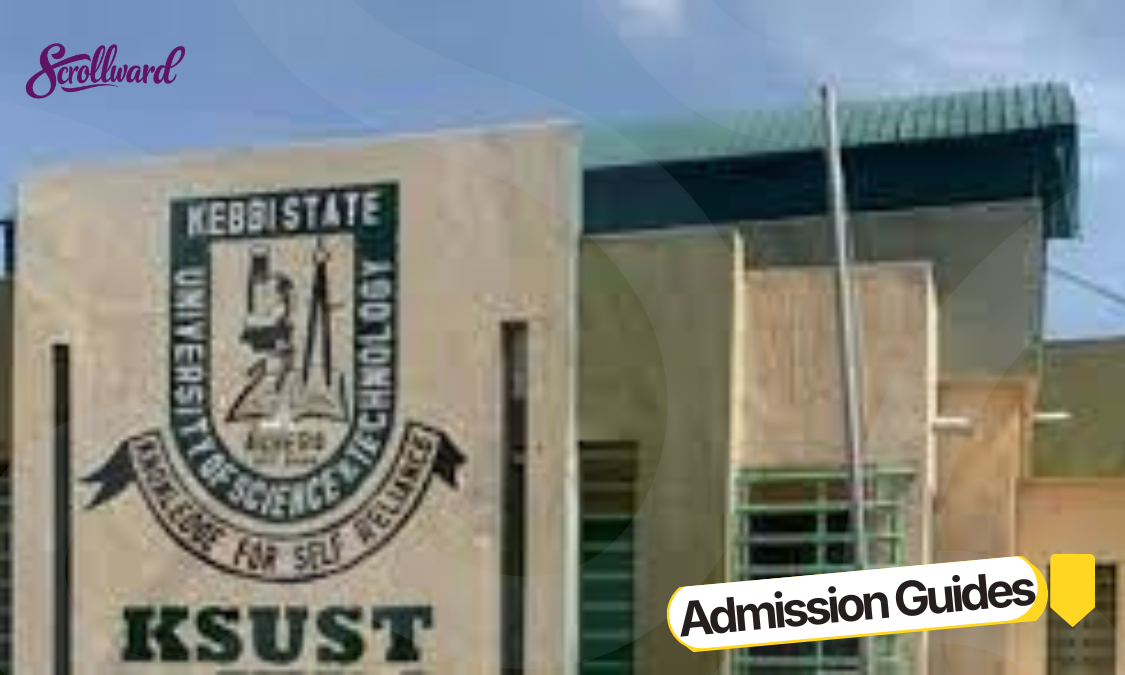
If you selected KSUSTA as your first choice in the 2026 JAMB UTME and you’ve been refreshing your phone waiting for news about the Post-UTME form, here’s something you need to know first: the school you applied to now has a new official name.
Kebbi State University of Science and Technology, Aliero (KSUSTA) was renamed Abdullahi Fodio University of Science and Technology, Aliero (AFUSTA) by the Kebbi State Government in late 2024. The university’s own website now refers to itself as AFUSTA, even though the “KSUSTA” name, the ksusta.edu.ng domain, and the applicant portal link are all still in active use. So if you see “AFUSTA” instead of “KSUSTA” on the portal or in official communication, you haven’t landed on the wrong page. It’s the same university.
This guide walks you through what’s currently known about the 2026/2027 Post-UTME and Direct Entry screening exercise, what you need to be eligible, what courses you can apply for, exactly how to apply, and what happens after you submit your form, based on what we could verify directly from the university’s official channels.
Who this guide is for
This is for you if:
- You selected AFUSTA (KSUSTA) as your first choice in the 2026 JAMB UTME and you’re waiting to register for screening.
- You’re a Direct Entry candidate with an ND, HND, NCE, or IJMB result and you want to know if you qualify.
- You’ve already registered and you want to understand what happens between now and admission.
If none of that describes you, this particular guide won’t be much use, but our other Post-UTME and admission guides for different institutions might be.
A quick note on accuracy before we go further
We checked the official AFUSTA/KSUSTA website (ksusta.edu.ng) directly rather than relying only on third-party education blogs, because that’s the standard we hold ourselves to. Here’s what that check turned up:
- The general admission requirements below (UTME, Direct Entry, O’Level, English and Mathematics requirements) are confirmed directly from the university’s official Admissions page.
- The specific screening dates and the ₦2,000 fee mentioned further down are being reported by education portals covering the 2026/2027 cycle, but at the time of writing, we could not find a dated official circular on ksusta.edu.ng confirming those exact figures. We’re including them because they’re useful for planning, but we’re flagging them clearly so you know to double-check before you pay anything.
Bottom line: before you pay any screening fee, confirm the current amount and deadline directly on the official application portal at applicant.safapply.com/ksusta or through the university’s admissions office.
What’s happening right now
AFUSTA (KSUSTA) has opened its Post-UTME and Direct Entry screening exercise for the 2026/2027 academic session. This is the screening every candidate who chose the university as their first choice in the 2026 UTME must go through before an admission offer can be finalised. Direct Entry applicants with recognised ND, HND, NCE, or IJMB qualifications are also invited to apply.
According to reports from education platforms tracking this cycle, registration opened on Monday, 27 July 2026 and is expected to close on Monday, 31 August 2026. Treat this window as provisional until you confirm it on the portal, since institutions sometimes extend or adjust dates without much notice.
Who is eligible to apply
Based on the university’s official general admission regulations, here’s what you need:
For UTME candidates (100 Level entry):
- You must have selected AFUSTA (KSUSTA) as your first-choice institution in the 2026 JAMB UTME.
- You need at least five credit passes in your SSCE (WAEC, NECO, NABTEB, or NBAIS), including English Language for every course and Mathematics for science-based courses, obtained in not more than two sittings.
- You must have sat the UTME and scored an acceptable standard in English Language plus at least three other subjects relevant to your intended course, as set out in the JAMB brochure.
For Direct Entry candidates (200 Level entry):
- Two A-Level passes in relevant subjects plus at least three O-Level credits in other subjects (two sittings maximum), or
- Three A-Level passes in relevant subjects plus at least two O-Level credits (two sittings maximum), or
- A National Diploma or equivalent Diploma from a recognised institution, with at least four O-Level credits in SSCE or its equivalent.
English and Mathematics requirements apply across the board:
- A credit in English Language at SSCE/GCE O-Level (or an accepted alternative like HSC A-Level General Paper, NCE General English, or a credit in IJMB English) is compulsory for every course.
- A credit in Mathematics at O-Level is required for all science and science-based courses, with a credit in IJMB Basic Mathematics accepted as an alternative.
If any of your subject combinations are unclear for your specific course, it’s worth checking your faculty’s exact requirements on the AFUSTA website before you register, since requirements can differ slightly by programme.
About the university, briefly
AFUSTA (KSUSTA) is a Kebbi State-owned university located in Aliero, along the Aliero-Sokoto Road. It was established in 2006 and has built its identity around science, technology, and agriculture-based programmes, though it also runs education, environmental science, and health science courses.
Based on the university’s official academic structure, AFUSTA currently runs six faculties, one college, and twenty-five academic departments:
- Faculty of Agriculture — Agricultural Economics and Extension, Animal Science, Crop Science, Forestry and Fisheries, Soil Science
- Faculty of Physical Sciences — Pure and Applied Chemistry, Mathematics, Computer Science and Information Technology, Physics
- Faculty of Life Sciences — Biochemistry, Microbiology, Animal and Environmental Biology, Plant Science and Biotechnology
- Faculty of Engineering — Civil Engineering, Electrical/Electronic Engineering, Mechanical Engineering, Information and Communication Technology
- Faculty of Education — Science Education, Education, Technology Education, Computer Education, Library and Information Science
- Faculty of Environmental Sciences — Architecture, Building, Quantity Surveying, Urban and Regional Planning
- College of Health Sciences — Anatomy, Physiology, Pharmacology and Therapeutics, Chemical Pathology, Morbid Anatomy and Forensic Medicine, Haematology and Blood Transfusion, Microbiology and Parasitology, Medical Biochemistry, Community Health, and Nursing Science
In practical terms, that means AFUSTA offers degree programmes ranging from B.Sc. Computer Science, B.Sc. Microbiology, and B.Eng. Civil Engineering, to B.Sc. Architecture, B.Sc. Nursing, and MBBS through the College of Health Sciences. If your intended course isn’t listed under a faculty here, it’s worth confirming directly on the university’s Academics page whether it’s currently offered, since course offerings can be added or reviewed between sessions.
How to apply for the screening
Here’s the process, based on how the university’s online screening exercise has typically run:
Step 1: Visit the official portal. Go to applicant.safapply.com/ksusta, the official Post-UTME application portal.
Step 2: Verify your JAMB details. Enter your JAMB registration number to confirm your eligibility for the screening.
Step 3: Create or access your account. If this is your first time on the portal, you’ll need to register an account before you can proceed.
Step 4: Pay the screening fee. Generate your payment invoice and complete payment through the approved channel on the portal. Confirm the exact amount currently displayed before paying — don’t rely on any figure you saw on a blog, including this one.
Step 5: Complete the online form. Fill in your personal and academic details accurately. Any mismatch between what you enter here and your JAMB record can delay or affect your admission processing.
Step 6: Submit and print your acknowledgement slip. Keep a printed or saved copy of your submission for your records.
Step 7: Upload your O’Level results to JAMB CAPS. This is a step candidates often forget. Your O’Level results need to be uploaded to the JAMB Central Admissions Processing System (CAPS) through an accredited JAMB CBT centre or JAMB office, separate from the university’s own portal. If this isn’t done, it can affect your chances of admission even if your screening application is complete.
Documents to have ready
Before you start your application, get scanned copies of these ready so you’re not scrambling midway through registration:
- Your 2026 JAMB UTME result slip or Direct Entry registration slip
- O’Level result certificates or statement of result printouts (WAEC, NECO, NABTEB, or NBAIS)
- A recent passport photograph
- For Direct Entry: your ND, HND, NCE, or IJMB result/transcript
Common mistakes to avoid
Entering details that don’t match your JAMB record. Your name, date of birth, and other bio-data on the screening form should match your JAMB profile exactly. Even small differences (a missing middle name, a typo in your surname) can create problems when the university tries to verify your record.
Forgetting to upload O’Level results to JAMB CAPS. This is easily the most common oversight, and we’ve given it its own section below because of how often it trips candidates up.
Registering with an unclear or wrongly cropped passport photograph. Use a recent, clear passport photograph as specified on the portal. A blurry or outdated photo is a small thing that can still cause avoidable delays.
Waiting until the last few days to register. Portals can slow down or experience technical issues when large numbers of candidates rush to register close to a deadline. Registering early gives you room to fix any errors calmly.
Assuming screening means the same thing every year. Processes, fees, and formats can change between admission cycles. Don’t rely purely on what happened last year, or on what a friend who applied two sessions ago tells you. Confirm directly on the current portal.
What nobody tells you about this stage
A lot of candidates treat Post-UTME registration as the finish line and relax once they’ve submitted the form. It isn’t. Your JAMB CAPS profile is where the actual admission decision gets recorded and where you’ll eventually accept or reject an offer. Some candidates complete their university screening perfectly but forget to upload their O’Level results to CAPS, and that single oversight can quietly cost them a spot. Treat the screening form and your CAPS profile as two separate, equally important tasks.
What happens after you submit your screening form
Once your registration and payment are complete, here’s the general sequence to expect:
- The university reviews submitted applications against JAMB records and the eligibility criteria for each course.
- An admission list is compiled and forwarded to JAMB for confirmation, in line with the standard CAPS process used across Nigerian universities.
- Your JAMB CAPS profile updates to reflect your admission status. This is why checking CAPS regularly matters more than refreshing the university portal.
- If you’re offered admission, you’ll need to accept it on CAPS within the window JAMB provides, then complete the university’s own post-admission requirements (acceptance fee, further document submission, and so on).
Because the exact timeline for list release wasn’t confirmed on the official site at the time of writing, we can’t give you a specific date to expect your result. Keep an eye on both the AFUSTA admissions page and your JAMB CAPS profile rather than relying on rumours or unofficial “admission list out” posts circulating on social media.
Frequently asked questions
Is the KSUSTA Post-UTME screening a written exam?
Based on the university’s current process, the screening described in recent cycles has been conducted online without a physical written test. Confirm this hasn’t changed for your session on the official portal.
Do I need to travel to Aliero for screening?
Recent screening exercises have been run as fully online processes, meaning physical travel to the campus for screening itself hasn’t been required. Always confirm this directly, since policies can change between cycles.
What if AFUSTA wasn’t my first choice on JAMB?
Generally, candidates who did not select the university as their first choice are not eligible for its Post-UTME screening. If you’re in this position, you’d typically need to explore JAMB’s change of institution window, where available.
Is the ₦2,000 screening fee confirmed?
This figure is being reported by several education platforms for the current cycle, but we couldn’t verify it against a dated official circular at the time of writing. Confirm the exact fee on the payment page before you pay.
Can I apply if I’m still awaiting my WAEC or NECO result?
Requirements around awaiting-result candidates vary by institution and by cycle. Rather than guess, check the current portal instructions directly, since applying with incomplete or unconfirmed results when it isn’t permitted can affect your application.
What courses does AFUSTA (KSUSTA) offer?
The university runs programmes across six faculties and a College of Health Sciences, including Computer Science, Microbiology, Biochemistry, Civil and Electrical Engineering, Architecture, Building, Nursing Science, and MBBS, among others. See the full faculty breakdown above.
Is admission guaranteed once I complete the screening?
No. Completing screening makes you eligible for consideration. It doesn’t guarantee an admission offer, since places are limited and allocation depends on your scores, your course’s competitiveness, and available capacity.
If you’ve made it this far, you already know more about this screening than most candidates who just scroll past the headline. Get your documents ready, register on the official portal, confirm the current dates and fee for yourself, and don’t forget to update your O’Level results on JAMB CAPS.
Got a question about the AFUSTA/KSUSTA screening or anything else about your admission process? Drop it in the comments below, we’ll be glad to help.
